

Lutein belongs to the group of carotenoids. These are pigments found in particularly large quantities in fruits and vegetables and cannot be produced by the human body itself. Due to their chemical structure, they can, among other things, absorb light and neutralize free radicals. This makes them so-called antioxidants, which help protect cells from damage caused by free radicals – also known as oxidative stress.
Free radicals are formed through various metabolic processes. However, the human body can also be confronted with free radicals due to external influences such as solar radiation (UV light), exhaust fumes, fine dust, or cigarette smoke. Especially immediately after birth, newborns are exposed to very strong oxidative stress, as their environment changes radically due to birth, which stresses the body. This applies even more to premature babies, as their bodies are not yet fully prepared for the transition to the outside world.
Antioxidants are believed to help prevent cell damage and thus slow down cell death. The carotenoid zeaxanthin is very similar to lutein, has comparable properties, and is sometimes found in the same foods as lutein, which is why many scientific studies examine both substances together. Lutein is also used under the abbreviation E161b as a dye in food production.
Lutein belongs to the group of carotenoids. These are pigments found in particularly large quantities in fruits and vegetables and cannot be produced by the human body itself. Due to their chemical structure, they can, among other things, absorb light and neutralize free radicals. This makes them so-called antioxidants, which help protect cells from damage caused by free radicals – also known as oxidative stress.
Free radicals are formed through various metabolic processes. However, the human body can also be confronted with free radicals due to external influences such as solar radiation (UV light), exhaust fumes, fine dust, or cigarette smoke. Especially immediately after birth, newborns are exposed to very strong oxidative stress, as their environment changes radically due to birth, which stresses the body. This applies even more to premature babies, as their bodies are not yet fully prepared for the transition to the outside world.
Antioxidants are believed to help prevent cell damage and thus slow down cell death. The carotenoid zeaxanthin is very similar to lutein, has comparable properties, and is sometimes found in the same foods as lutein, which is why many scientific studies examine both substances together. Lutein is also used under the abbreviation E161b as a dye in food production.
In humans, the carotenoid lutein is found mainly in the eyes, specifically in the macula. This refers to the area of the retina where the photoreceptor cells are particularly densely packed. This small area is therefore also considered the point of sharpest vision and is called the “yellow spot” because the retina appears yellow here due to the high amount of lutein and zeaxanthin.
Some studies have shown that lutein has a protective effect in the eye. People who work on screens or use laptops, tablets, or smartphones for other reasons expose themselves to blue light (wavelength between 450–495 nm). Light of these wavelengths can promote the formation of free radicals and increase the risk of certain eye diseases. Due to its structure, lutein absorbs part of this light. Studies also indicate that there is a connection between the level of lutein and zeaxanthin in eye tissue and improved contrast vision, among other things. Various eye diseases are apparently linked to oxidative stress. There is evidence that these diseases occur less frequently in people with a good supply of lutein and zeaxanthin.
Good to know
In particular, the connection between age-related macular degeneration (AMD) and various nutrients has been investigated in many studies. AMD is one of the most common eye diseases in old age. It involves a gradual loss of vision in the sharpest area of sight. A long-term study investigated the long-term intake of tablets containing a combination of lutein and zeaxanthin, vitamins C and E, zinc, and copper in people already suffering from AMD. The results indicate that this mixture helps to slow the progression of AMD.
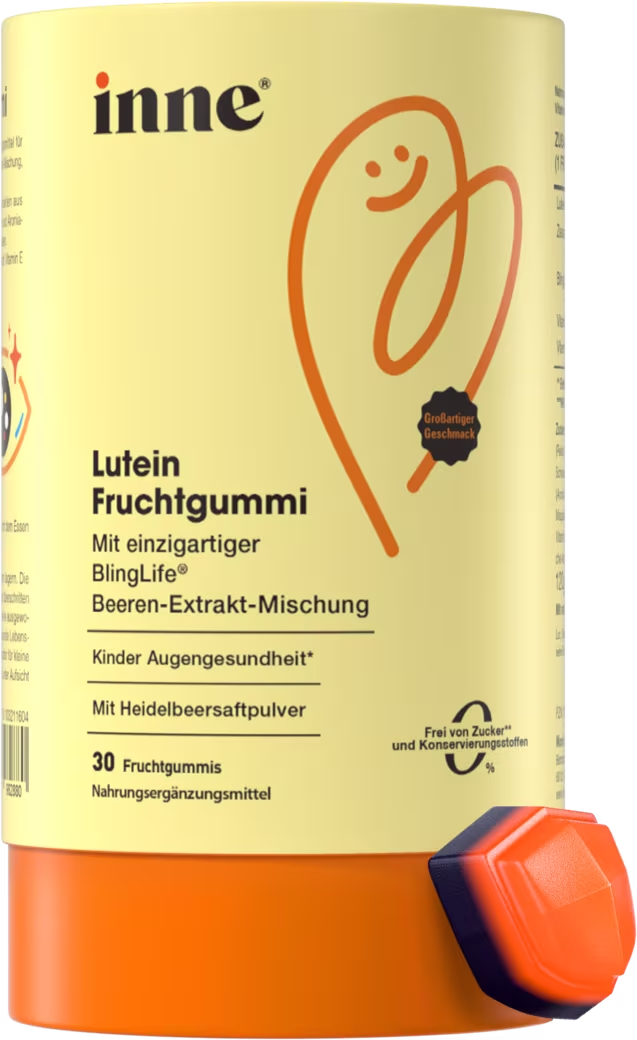
inne® Lutein Fruchtgummi
*Vitamin A trägt zur Aufrechterhaltung der normalen Sehkraft bei
** < 0,5 g Zucker pro 100g
However, lutein is not only important for eye function in adults but also plays a role in the development of eyes and brain in unborn children, as well as in babies and toddlers. Therefore, colostrum contains a relatively high amount of lutein to ensure the supply to the newborn child. The content in the milk depends on how much lutein the breastfeeding mother consumes.

Particularly high concentrations of lutein (and zeaxanthin) are found in green vegetables such as spinach, chard, kale, and broccoli, as well as in smaller amounts in corn and egg yolks. Since lutein is a fat-soluble substance, its absorption improves when lutein-rich foods are prepared or eaten together with fat. Cooking does not harm the pigment; it even seems to facilitate the absorption of lutein through food.
Lutein, especially in combination with other nutrients like zeaxanthin, is important for maintaining vision and for the development of eyes and brain in babies and toddlers. To meet the demand, a balanced diet with plenty of vegetables is usually sufficient. There are indications that lutein can contribute to improving eye health in adulthood and in various diseases. However, research does not yet provide concrete recommendations here.